
Wastewater Solutions for Auto Parts & Aerospace Manufacturers
Machining coolant, plating rinse, anodizing baths, and parts-washing effluent — compliant hauling and disposal built around how your facility actually runs.
Auto parts and aerospace manufacturing plants generate some of the most complex industrial wastewater streams in the country — machining coolant, plating rinse water, anodizing baths, and parts-washing effluent, all carrying heavy metals, oils, and process chemicals that can’t go straight to the sewer.
Getting it wrong isn’t just a compliance risk. A single load mischaracterized as non-hazardous can expose a facility to significant fines and liability. EES provides compliant hauling and disposal solutions backed by ENCON’s 30+ years of industrial wastewater experience.
What Wastewater Do These Facilities Produce?
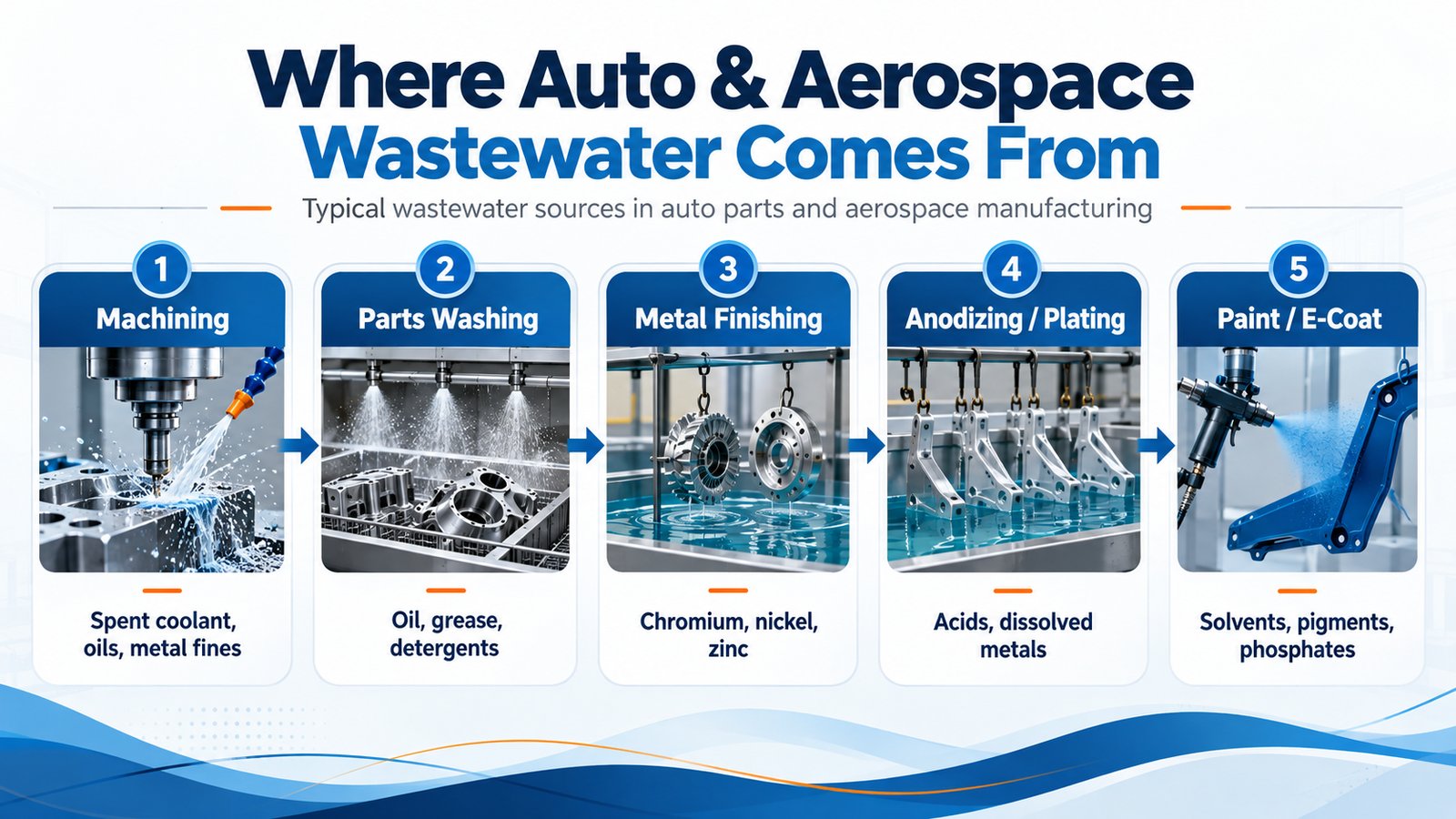
Each stage of production creates a different contaminant profile. Here’s what we typically see from each industry.
Auto Parts Manufacturing
Wastewater comes from several stages of production, each with its own handling requirements.
-
Machining coolant — Straight oils, soluble oil emulsions, and synthetic fluids from cutting, grinding, drilling, and milling of engine, transmission, gear, axle, and brake components. Typically discarded when it turns rancid or performance degrades; disposal requirements depend heavily on the additive package.
-
Parts washing water — Alkaline cleaners, detergents, and surfactants that pick up oil, grease, and drawing compounds as wash baths become spent, gradually or all at once during a tank cleanout.
-
Metal finishing rinse water — Zinc, nickel, and chromium from plating and phosphating operations on fasteners, brackets, and other hardware.
-
Paint and e-coat wastewater — Solvents, pigments, and phosphates from pretreatment and coating lines. Often one of the more complex streams, because it can’t be mixed with cleaner rinse water without complicating treatment.
-
Swarf and grinding fines — Metal particulate carried in rinse water, sometimes hazardous depending on the base metal and fluid used.
Aerospace Parts Manufacturing
Tighter tolerances and more aggressive surface treatments show up in the wastewater.
-
Anodizing wastewater — Chromic, sulfuric, boric-sulfuric, or phosphoric acid baths used on aluminum, titanium, and magnesium structural components.
-
Chrome plating baths and rinses — Chromic acid electrolyte used on landing gear, hydraulic components, and fasteners. Hexavalent chromium is a major regulatory driver and one of the most heavily scrutinized streams in the industry.
-
Chem-film / conversion coating rinse — From conversion coatings applied to aluminum for corrosion protection and paint adhesion, and to touch up damaged anodized surfaces before assembly.
-
Passivation wastewater — Nitric or citric acid baths on stainless steel and titanium parts, used to remove free iron and improve corrosion resistance.
-
Chemical milling and etching — Caustic and acid etchants carrying dissolved metals and fine particulates, common in structural aluminum part production.
-
Precision machining coolant — Similar chemistry to auto parts, but used on titanium and nickel-based superalloys that bring their own handling challenges.
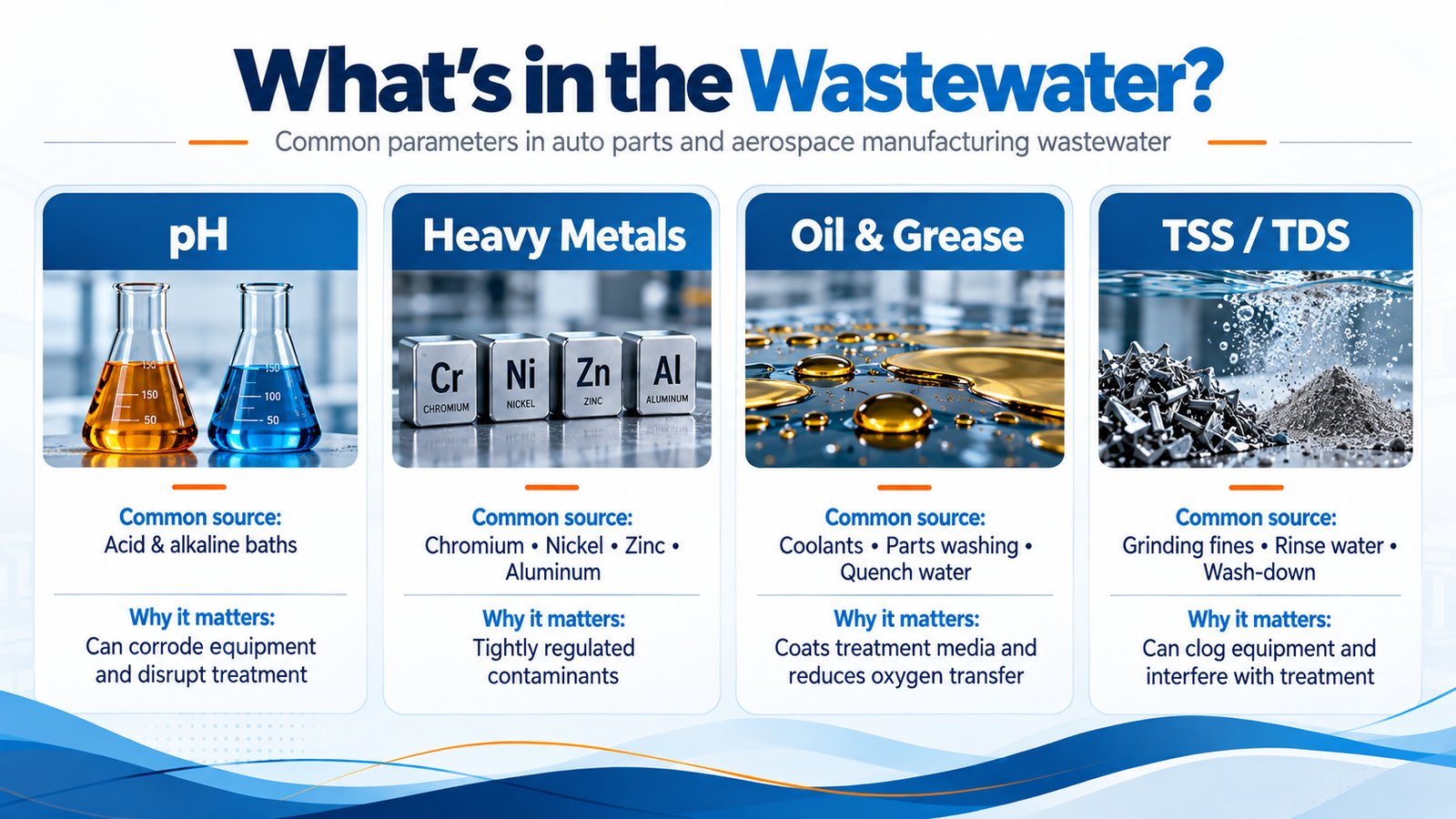
The Parameters That Drive Handling
Despite coming from different processes, auto parts and aerospace wastewater share a core set of regulated parameters that determine how each load has to be handled.
Know the Rules Before the Truck Arrives
Auto parts and aerospace manufacturers fall under overlapping federal and local rules that shape how wastewater can be stored, treated, and discharged.
As the generator, you remain responsible for your waste from cradle to grave — even after it leaves your facility.
Getting the classification right up front avoids the two most common and costly mistakes: under-classifying a hazardous stream, or over-paying to treat a stream as hazardous when it doesn’t need to be.
-
40 CFR Part 438 — The EPA’s Metal Products & Machinery Point Source Category regulates process wastewater from manufacturing, rebuilding, or maintaining metal parts, covering many auto parts and aerospace operations directly.
-
NPDES and local sewer discharge limits — Facilities discharging to a sanitary sewer are typically bound by local limits on pH, heavy metals, and oil & grease set by their sewer authority, on top of any state or federal permit.
-
RCRA hazardous waste codes — Spent plating and metal finishing wastes commonly fall under F006 (electroplating wastewater treatment sludge) or F019 (chemical conversion coating of aluminum), which dictate handling, manifesting, and disposal.
-
Hexavalent chromium controls — Chrome plating and chromic acid anodizing operations face some of the strictest air and wastewater standards in metal finishing, given the health risks of hexavalent chromium exposure.
Is spent machining coolant hazardous waste?
It depends on the metal being machined and the additive package in the fluid. Spent coolant must be tested or evaluated against generator knowledge to determine hazardous status. Many shops find their coolant qualifies as non-hazardous, but chlorinated or heavy-metal-bearing fluids often don’t.
Can chromium-bearing wastewater be discharged to the sewer?
Only after treatment to reduce hexavalent chromium to trivalent chromium and bring concentrations under your local sewer authority’s discharge limits. Direct discharge of chromic acid rinse water is not permitted.
How much does industrial wastewater hauling cost?
Cost depends on waste classification (hazardous vs. non-hazardous), volume, and disposal method. Tell us what you have and we’ll provide a clear, itemized quote.
What permits does an auto parts or aerospace manufacturer need for wastewater?
Requirements vary by discharge method and location, but typically include a local sewer discharge permit if connecting to a POTW and, separately, proper hazardous waste generator registration if any streams are classified as hazardous under RCRA.
Does EES handle both hazardous and non-hazardous wastewater?
Yes. EES hauls both classifications, with documentation and disposal routing that matches each stream’s classification. Learn more about our liquid waste hauling →